
# Complete Guide to Online Tongits: Rules, Gameplay Mechanics, and Winning Systems
Tongits stands as the undisputed king of card games across the Philippine archipelago. Born in the northern provinces of Luzon during the early 1990s, this fast-paced three-player rummy variant quickly transitioned from neighborhood sidewalk tables, barangay fiestas, and family reunions into an iconic cultural staple. In the modern era, the migration of Tongits to digital mobile screens has preserved the psychological intensity, bluffing tactics, and mathematical calculation of the street original while introducing automated scoring, encrypted shuffling, and round-the-clock table availability.
Mastering online Tongits requires far more than casual card-matching. Success demands a rigorous understanding of the opening deal, legal meld formation, draw-and-discard discipline, defensive monitoring, and the strategic timing needed to challenge opponents through a declared fight or achieve an outright Tongits victory. This comprehensive guide walks through every operational rule, game mechanic, and procedural protocol necessary to compete confidently across digital tables.
The Fundamentals of Table Setup and Dealing
Online Tongits is played with a standard international 52-card deck without jokers. The game is engineered exclusively for three active players. Unlike four-player card games or two-player head-to-head duels, a three-player dynamic creates a tense balance of power where two conservative players can inadvertently feed a third aggressive participant if discards are mishandled.
[Draw Pile / Bunot]
                   [Discard Dump / Tapon]

          Player 2                        Player 3
       (12 Cards)                      (12 Cards)

                         Player 1
                      (Dealer / 13 Cards)
At the start of each round, the digital table software assigns one player as the dealer, rotating the position clockwise after every completed hand. The dealer receives 13 cards, while the two remaining participants receive 12 cards each. The remaining 15 undealt cards form the face-down central draw deck, known in local parlance as the bunot pile.
Because the dealer holds 13 cards from the opening deal, they do not draw from the central deck on the very first turn. Instead, play commences immediately when the dealer assesses their initial hand and discards one card face-up into the community discard area. This initial discard initiates the clockwise turn cycle.
Valid Card Melds: Building Your Bahay
The primary objective in Tongits is to organize the cards in your hand into valid combinations called melds, colloquially referred to across the Philippines as bahay (house). Once organized into legitimate combinations, cards can be laid down onto the digital table during your active turn to reduce the cumulative numerical point weight remaining in your hand.
Melds in Tongits are strictly divided into two standard rummy structures:
| Meld Category | Local Terminology | Structural Requirements | Concrete Examples |
|---|---|---|---|
| Sequence / Run | Escalera | Three or more consecutive cards sharing the exact same suit. | `4♠ - 5♠ - 6♠` or `9♥ - 10♥ - J♥ - Q♥` |
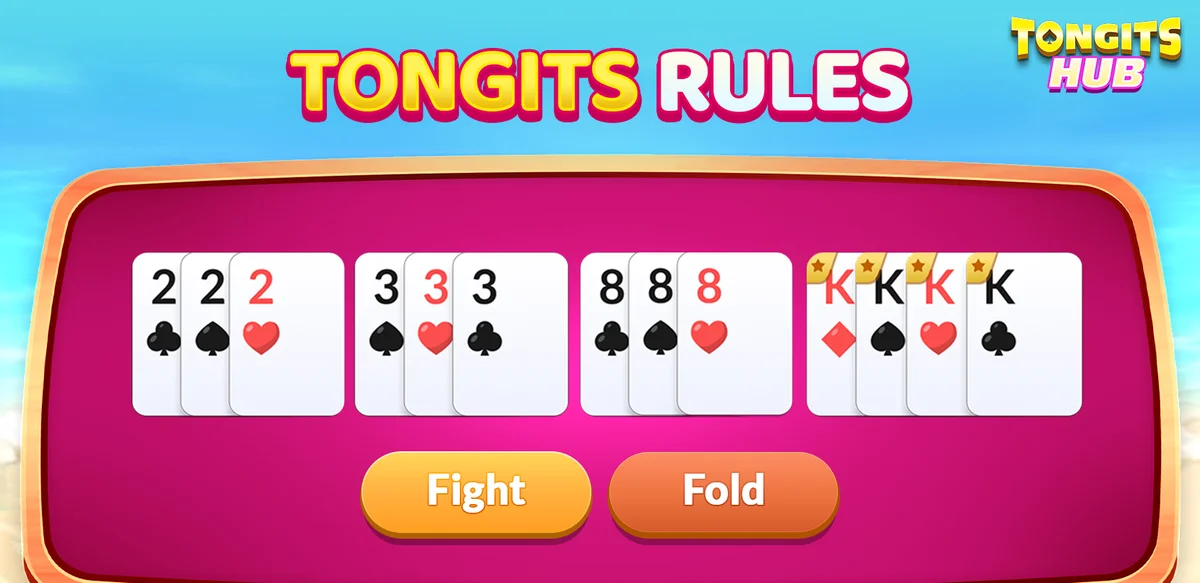
| Set / Group | Barkada / Trio | Three or four cards of identical numerical rank across different suits. | `7♣ - 7♦ - 7♠` or `K♠ - K♥ - K♦ - K♣` |
Special Rules for Melds
- Ace Positioning: In Tongits, the Ace functions with a numerical value of 1 point. In sequences, it is strictly low. Valid Ace sequences must follow `A-2-3` of a matching suit. An Ace cannot wrap around high cards (for example, `Q-K-A` or `K-A-2` are illegal combinations under standard Philippine tournament rules).
- Four of a Kind: When a player holds four matching ranks (such as four Jacks or four Queens), they may lay them down together as a complete group. In some digital platforms, laying down a four-card set directly from your concealed hand without drawing triggers an immediate bonus payout from the table pot.
- Concealed vs. Exposed Melds: You are not legally required to lay down your combinations immediately upon forming them. You may choose to hold formed bahay secretly in your hand to prevent opponents from reading your hand distribution. However, holding cards carries significant risk if an opponent abruptly finishes the round or calls an uncontested fight.
Turn-by-Turn Gameplay Mechanics
Every standard turn in online Tongits adheres to a four-stage sequence: Draw, Meld, Sapaw, and Discard. Players must execute these phases within the digital countdown timer allocated per turn, typically set between 10 and 15 seconds.
> 🔄 Execution Workflow: [1. Draw / Chow] ---> [2. Lay Meld (Optional)] ---> [3. Sapaw (Optional)] ---> [4. Discard / Tapon]
The Draw Phase (Bunot vs. Chow)
When your turn begins, you must obtain a new card through one of two legal methods:
- Drawing from the Stock Pile (Bunot): You tap the face-down central deck to draw the top unknown card into your hand. This is the standard, safest action because it reveals no strategic information to your opponents.
- Picking up the Discard (Chow / Pulot): You can only pick up the card discarded by the player immediately to your left (the player whose turn preceded yours). You cannot pick up discards thrown by the player to your right, nor can you retrieve previously buried discards from earlier turns. Furthermore, you may only Chow if the discarded card immediately forms a valid meld with two or more cards already in your hand, and that new meld must be exposed face-up on the table immediately. You cannot pick up a discard simply to stash it into your private hand.
The Melding Phase (Paglalapag)
After acquiring your new card, you have the option to expose one or more completed melds from your hand onto your personal board section.
Exposing a meld accomplishes two vital objectives:
1. It reduces your hand's total point score, which is critical if the round ends in a point showdown.
2. It establishes your eligibility to initiate a Fight (challenge) later in the game. Under official rules, a player who has never laid down at least one exposed meld cannot call a fight and is vulnerable to being burned (sunog).
The Sapaw Phase (Laying Off)
Sapaw is a unique strategic mechanic that distinguishes Tongits from western rummy variations. If you hold a card in your hand that naturally extends or connects to any existing exposed meld on the table—whether that meld belongs to you or an opponent—you may play that card onto the meld.
- Sapaw on Sequences: If an opponent has exposed `5♦ - 6♦ - 7♦`, and you hold the `4♦` or the `8♦`, you can tap their exposed run and attach your card to it.
- Sapaw on Sets: If any player has exposed three 9s (`9♠ - 9♥ - 9♣`), and you hold the `9♦`, you can attach the fourth 9 to complete the four-card set.
Executing a sapaw allows you to dispose of dead cards without exposing new sets of your own. However, placing a sapaw on an opponent's meld locks that opponent from calling a Fight on their very next turn, providing a potent defensive control tool.
The Discard Phase (Tapon)
Every turn must conclude with discarding one card face-up into the central discard lane. Once your discard hits the table, your turn terminates, and the action advances clockwise. The card you discard becomes available for the next player to evaluate for a potential Chow.
Careful discarding is the hallmark of elite Tongits strategy. Tossing a card that enables the next player to Chow is known as pagpapakain (feeding). Feeding an opponent gives them free board presence, accelerates their hand reduction, and unlocks their ability to declare a fight.
Victory Conditions and Endgame Resolutions
A round of online Tongits concludes through one of four primary pathways: an outright Tongits, an initiated Fight, a Deck Depletion Draw, or an opening Bisaklat.
[Round Resolution][Tongits] [Fight] [Deck Exhausted] [Bisaklat]
Hand Emptied Lowest Score Hand Points Natural Deal
Instant Win Challenge Wins Showdown Win Automatic
Achieving Outright Tongits
A player claims an outright Tongits victory when they successfully eliminate all cards from their hand through legitimate melds, sapaw attachments, and an optional final discard.
When a player achieves Tongits:
- The round ends immediately.
- The winning player collects the full table pot along with pre-agreed bonus units from both losing participants.
- Neither opponent has the right to challenge or count remaining hand scores; the victory is absolute.
Initiating and Resolving a Fight (Hamon / Draw)
If the central deck still contains cards, but a player believes their remaining unmelded cards carry a lower total point value than either opponent's hand, that player may declare a Fight at the start of their turn instead of drawing a card.
Conditions Required to Call a Fight:
- You must have exposed at least one valid meld on the table.
- You must not have been hit with a sapaw by any opponent during the turn cycle immediately preceding your current turn. If someone placed a sapaw on your exposed cards, your ability to call a fight is frozen until you complete a standard draw-and-discard turn.
- No opponent has called a fight during the same turn.
Responses to a Declared Fight:
When a player initiates a fight, the remaining two opponents must evaluate their own hands and choose between two options:
1. Fold (Tiklop): The player concedes the hand. They accept a standardized minor penalty payment and shield themselves from double-penalty losses.
2. Challenge (Laban): The player believes their unmelded card point count is equal to or lower than the challenger's hand.
If one or both opponents challenge, all active contenders reveal their concealed cards. The player possessing the strictly lowest point score wins the contest. If the challenger loses the showdown, they are designated as talo sa hamon and must pay heavy penalty compensation to the victor.
Central Deck Depletion (Ubos Bunot)
If all 15 cards in the central draw pile are drawn and the final player completes their discard without anyone declaring Tongits or a Fight, the game enters a mandatory point tally.
Every player who has opened at least one exposed meld displays their remaining hand cards. The software calculates each player's numerical score:
- The player with the lowest cumulative point total claims the victory.
- If two players tie for the lowest score, the player who held dealer position or sat closest to the dealer's left usually holds tie-breaker priority under standard house rules.
The Bisaklat Natural Win
An exceptionally rare occurrence, Bisaklat occurs when the dealer's initial 13-card hand or a non-dealer's initial 12-card hand can be partitioned entirely into valid melds immediately upon distribution. If a player receives a complete hand without needing a single draw, they can declare Bisaklat prior to making any move, winning the round instantly with premium bonus multipliers paid by all table members.
Scoring System and Point Calculations
Understanding the numerical point weight of every individual card is fundamental to risk management during the mid-to-late stages of a round.
Card Point Values
| Card Rank | Face Representation | Point Value | Strategic Assessment |
|---|---|---|---|
| Aces | `A♠`, `A♥`, `A♦`, `A♣` | 1 Point | Pristine defensive card. Lowest weight during a fight. |
| Low Numericals | `2`, `3`, `4`, `5` | Face Value (2 to 5) | Ideal retention cards for endgame showdowns. |
| Mid Numericals | `6`, `7`, `8`, `9` | Face Value (6 to 9) | Moderate risk; should be melded or dumped early. |
| High Numericals | `10` | 10 Points | High liability in a point challenge. |
| Face Cards | `Jack`, `Queen`, `King` | 10 Points Each | Maximum danger. Priority targets for early discards. |
The Burned Player Rule (Sunog)
A player is declared burned (sunog) under two specific conditions:
1. They failed to expose a single valid meld onto the table before another player declared Tongits or successfully concluded a fight.
2. They held an unexposed four-of-a-kind without declaring it, or failed to qualify before the draw pile ran dry.
A burned player suffers the maximum financial penalty allowed at the table stake level. They cannot participate in the point tally during a deck-depletion showdown, their score is rendered null and void, and they must compensate the winner with doubled penalty units. Avoiding the sunog state is the primary defensive imperative for any beginner or intermediate player.
Digital Platform Features and Safety Protocols
Transitioning from home games to regulated digital platforms brings structural enhancements that ensure integrity, fairness, and swift financial operations.
Regulated Digital Ecosystem
| Certified RNG Card Shuffling | Automated Turn Clocks |
|---|---|
| PAGCOR Regulatory Oversight | Integrated E-Wallets |
| Anti-Collusion Bot Tracking | Instant Pot Distribution |
Certified Random Number Generators (RNG)
In physical street games, manual shuffles can suffer from mechanical bias or intentional card manipulation. Regulated online platforms utilize cryptographically secure Random Number Generators certified by international test labs. These mathematical algorithms guarantee that every 52-card distribution is completely independent, non-predictable, and immune to dealer interference.
To confirm that you are playing in a legal, audited environment, always ensure the platform operates under a verifiable domestic gaming permit authorized by PAGCOR.
Financial Integration via Philippine E-Wallets
Modern online tables integrate seamlessly with primary Philippine mobile payment channels. Players can fund their balance and withdraw earnings within minutes through trusted financial infrastructure:
- Fast, cashless wallet top-ups through GCash.
- Instant real-time transfers and verification using Maya.
These secure channels eliminate the disputes and physical cash management vulnerabilities historically associated with casual card circles.
Responsible Play and Table Discipline
Because digital cards can be played in continuous successive rounds, maintaining emotional discipline and strict bankroll boundaries is essential. Never chase losses during an adverse run of cards, and set strict session time limits before entering any real-stake lobby.
If card gaming ever ceases to be entertaining or begins impacting your personal finances or domestic well-being, reach out immediately for confidential guidance from international player support foundations such as Gamblers Anonymous and Gambling Therapy.
Frequently Asked Questions
Can I pick up a discarded card just to hold it in my hand?
No. Under official Philippine Tongits rules, you can only Chow a discarded card if you can immediately pair it with cards from your hand to form a valid three-card or four-card meld. That newly created meld must be placed face-up on the table for all participants to see during that exact turn.
What happens if I am hit with a sapaw on my meld?
If an opponent adds a connecting card (sapaw) to your exposed meld, you are prohibited from declaring a Fight on your very next turn. You must execute a standard draw from the stock pile, meld or discard, and wait until your subsequent turn before any challenge can be called.
Why do picture cards carry 10 points while Aces are only 1 point?
Tongits scoring assigns standard values where Jacks, Queens, and Kings are weighted heavily at 10 points each to penalize players holding uncoordinated high cards. Aces are evaluated as low cards worth only 1 point, making them exceptionally valuable to retain when angling for a low-point fight.
Can an Ace be connected to a King in an Escalera run?
No. In Tongits, the Ace is strictly low. Legitimate runs featuring an Ace must be formatted as `A-2-3` of the same suit. Combinations such as `Q-K-A` or `K-A-2` are illegal and will be rejected by the gaming software.
What is the penalty for being burned (sunog)?
A burned player is disqualified from the hand's final point showdown. They must pay the maximum table penalty, including compensation for all bonus bets, and are treated as the ultimate loser of the round regardless of what cards they held in their private hand.
Is online Tongits legal in the Philippines?
Yes, online Tongits is legal when played on digital gaming platforms officially licensed and supervised by PAGCOR. Regulated platforms enforce player verification, fair RNG shuffling, and strict responsible gaming measures.
Connected Table Game Guides
- Tongits Drawing and Dumping Tactics
- Tongits Scoring and Fight System
- Pusoy Dos Card Rankings and Strategy
- Color Game Peryahan Odds and Probabilities
- Filbet Pinoy Table Games and Perya Portal
Official Member Access and Registration
To access real-money gaming tables, practice slot mechanics, or claim verified promotional credits, visit the official Filbet Portal on mobile or desktop.